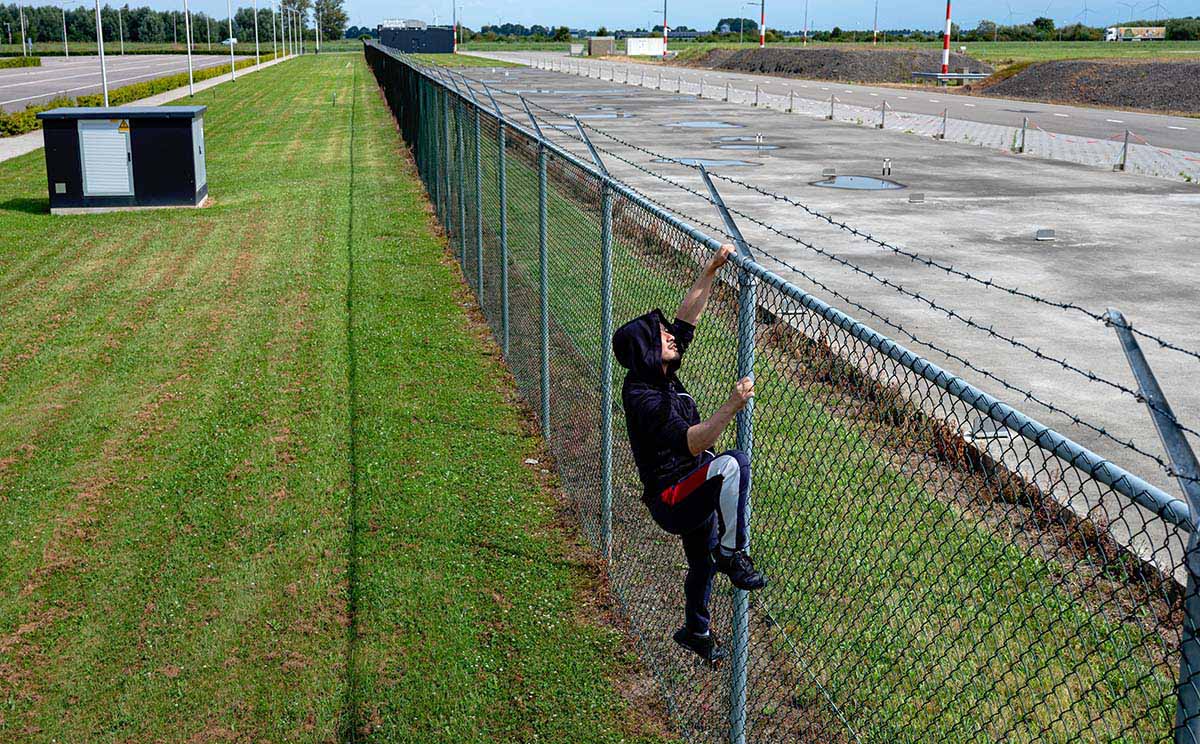
In the security industry, operators must respond quickly to critical events. When a camera detects a potential threat, it sends an alarm to an operator for review. However, in complex perimeter environments, sensitive cameras often trigger false alarms. Reviewing each one becomes inefficient, leading to fatigue and delays. While no single camera can eliminate unwanted or false alarms entirely, our investment in deep learning helps tackle this challenge head-on.
At our research center in Hildesheim, Germany, we develop technologies that enable cameras to extract insights from video data-boosting analytics accuracy in complex environments like perimeter security, city traffic or school safety.
Leveraging Bosch’s research, we’re creating intelligent solutions with real-world impact. One example is Dr. Emil Schreiber, a senior deep learning engineer who leads efforts to apply deep learning to cloud-based alarm verification.
“We constantly improve deep learning technology by cooperating with customers and retraining video data from real-life installations,” said Schreiber. “As engineers, we bring technical expertise to the process. And we need to hear and understand customer needs and then use data from the field to make continuous improvements. Working closely with our customers, we can achieve high accuracy of actual events.”
This collaborative approach helped us gain valuable insights into securing remote and unstaffed locations, such as construction sites-frequent targets for theft and vandalism. Today, cloud-based solutions offer a more effective way to protect these areas using only an on-site camera. Video analytics can alert users to real threats or trigger prerecorded audio to deter intruders.

How deep learning is paving the way for intelligent alarm verification in the cloud
The importance of real-world data
To manage the many steps involved in cloud-based alarm verification, the research team is structured into four groups: data, deep learning, embedded solutions, and cloud solutions. The process begins with the data team, which collects and labels datasets. These are passed to Schreiber’s deep learning team to train the neural network. Once ready, the model is handed to the embedded team to ensure it functions within the camera. Finally, the cloud team validates deployment in the cloud environment.
“Our analytics are very robust,” said Schreiber. “They are highly reliable and accurate, like object detection for vehicle counting. We wouldn't have as good of a solution if we didn't look at the data from vehicles or objects that customers are collecting.”
Because video data may contain sensitive information, Schreiber emphasizes the importance of secure and compliant data handling. “We work with our legal team and data protection officers to ensure it’s done correctly.”
Filtering out unwanted alarms
As demand for video surveillance grows, organizations seek scalable solutions that minimize upfront investment. Remote sites like energy and construction facilities are especially challenging due to their isolation and lack of staff.
Customers want fewer false alarms so operators can focus on real threats. Our cloud-based alarm verification service filters out irrelevant alerts using deep learning algorithms trained on real-world data. These models recognize patterns and improve over time-enabling faster, more accurate responses. The system pre-checks alarms and compares results across scenarios to optimize performance, ensuring only relevant events reach operators.
Looking ahead-smarter cameras, less work
When multiple cameras are installed around a perimeter, calibrating each one can be time-consuming. Schreiber and his team are working on camera self-calibration to reduce this burden. “With calibration, our algorithms know the size of an object in an image,” said Schreiber. “Imagine a small rabbit running through an image. When the camera is calibrated, it would automatically be filtered out as an alarm because the camera's bounding box would detect that the movement is too small to be an object of interest. At the moment, users need to calibrate the camera manually. We hope this kind of calibration becomes so standard that it will be run automatically in the background or at least one button click for the user. Many more cameras will be calibrated, and customers will benefit from these reduced false alarm rates.”
Keeping the customer at the center
Customer collaboration is central to our development process. Through our UX approach, we involve users early in testing to validate the practicality of our solutions and services.
“We are at the intersection of real-world applications,” said Schreiber. “Sometimes in academia, there are minimal data sets from limited use cases that wouldn't allow you to solve a particular problem, nor make a product based on that. Applying technology with enough data to an actual scenario that will help the customer is quite interesting. Still, there is a big step between theory and application. It's fascinating to see what happens.”